May 20, International HR Day, arrives this year under a theme that asks something specific of the profession: "Empower People to Lead Change." It is a useful challenge, because empowering people requires HR to first examine whether its own systems are built for that purpose.
What makes International HR Day 2026 different is the shift in what is being asked of the function. HR is no longer being invited to support the business. It is being expected to shape it: to predict which skills will be scarce before the shortage becomes critical, to build cultures that retain people before attrition becomes expensive, and to demonstrate in board-level terms how people strategy connects to business outcomes. That expectation has moved from progressive organizations to mainstream ones, and it changes what good HR leadership actually looks like.
This year's International HR Day is an opportunity to listen to what the world's most influential CHROs are actually saying about what works, what does not, and what the profession needs to become next.
International HR Day was established to celebrate the contributions of HR professionals globally and to highlight the ways in which people strategy drives organizational outcomes. Observed every May 20, the day has grown from an industry acknowledgment into a genuine call to action for organizations to invest in their HR functions with the same rigor they apply to finance, technology, or operations.
The case for taking HR seriously has never been clearer in financial terms. Despite this, the gap between investment intent and investment reality persists. Organizations routinely spend nearly three times more on talent than on capital equipment, yet most do not manage workforce investment with comparable discipline. The World Economic Forum's pilot across 13 industrial sites found that organizations using a holistic talent approach reported a 52% improvement in workforce stability, a 34% improvement in financial performance, and a 28% improvement in productivity and operational safety.
These outcomes influence board-level discussions. And increasingly, boards are paying attention. As Ola Snow, CHRO at Cardinal Health, observed, the pandemic and the social justice movement put a spotlight on how important HR is in mitigating risk, protecting the organization, and creating value for business success. That spotlight has not been dimmed.
What defines excellent CHROs, according to N2Growth's Leaders40 methodology, is a rare combination of qualities that do not always appear together: business fluency, genuine empathy, adaptability under pressure, and visionary thinking about skills and capabilities the organization will need before it realizes it needs them. As Robin Leopold of JPMorgan Chase put it, HR's role is evolving to include enriching the experiences and growth of every employee, not just shaping the business from a structural standpoint.
This reflects a shift in mindset from HR as a compliance or service function to HR as an active contributor to business results. Amy Coleman at Microsoft has described this through the lens of a growth mindset culture, one where leaders are coached and developed rather than simply evaluated, and where inclusion is embedded in how decisions are made daily rather than managed through a separate program.
Listening carefully to what prominent CHROs are currently prioritizing reveals several consistent threads worth noting. Across industries, three patterns are becoming clear in how CHROs are thinking about the future of work.
The response is not fear but responsibility. Donna Morris at Walmart frames AI adoption around a clear imperative: identify new roles, reskill and upskill talent, and equip people to thrive in the next chapter of work. Trent Henry at EY describes using AI to allow the talent team to shift their focus from logistics to building relationships and interacting on a human level, with the technology doing the administrative work that previously consumed meaningful time.
Multiple CHROs emphasize that culture is not an HR program. Paige Ross at Blackstone describes a weekly Monday morning global all-hands meeting that sets the tone for the week, covers macroeconomic trends, and recognizes achievement. Tracey Franklin at Moderna talks about the Moderna Mindsets, a set of tools that codify what is unique to the company's way of working and make it concrete for both new and existing employees. Samantha Hammock at Verizon introduced Culture OS, a purpose-driven operating system that holds every employee accountable to the same values internally and externally.
Ola Snow at Cardinal Health describes a comprehensive listening strategy using surveys, focus groups, and fireside chats to understand where employees are in their lives and work journeys, recognizing that a workforce spanning four to five generations requires differentiated responses rather than uniform programs. Lynne Oldham at Stash makes a point that cuts across all of these themes: what cannot be replicated by a competitor offering a higher salary or a better title is an environment where employees feel inspired and have genuine clarity on how their work connects to the company's future. That clarity is an HR design problem, and it belongs at the top of the agenda.
Individual CHRO philosophy only matters if it translates into organizational behavior. The trends below reflect what is actually changing in how HR functions operate, invest, and measure themselves across large organizations in 2026.
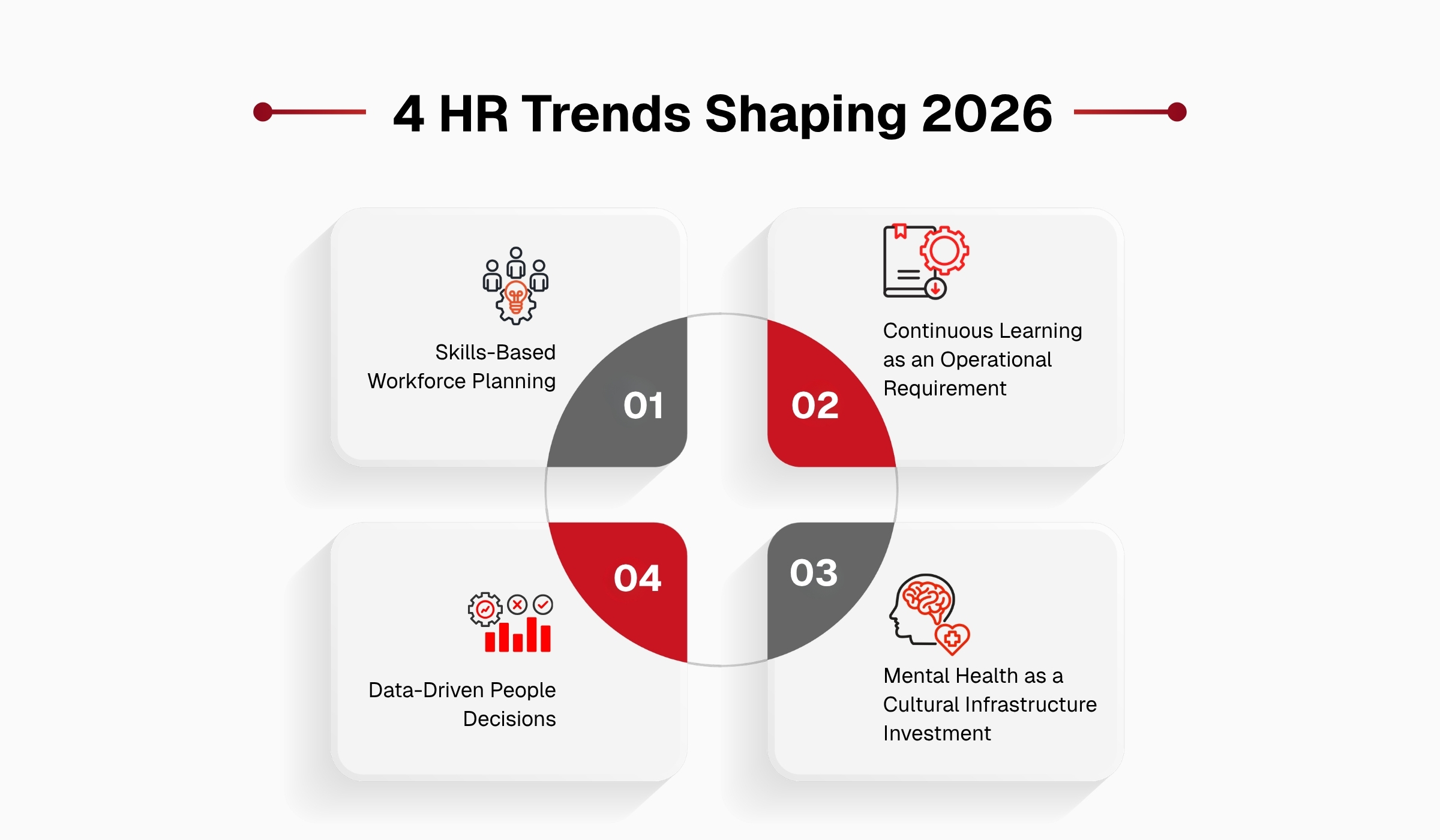
Skills-based workforce planning is replacing role-based hiring in a growing number of organizations. Rather than managing job descriptions, leading HR teams are building unified skills databases that include both employees and contractors, tracking which capabilities are available, which are scarce, and which will be needed in the next 12 to 18 months. This makes internal mobility faster and more precise, reducing the cost and time associated with external hiring for roles that could be filled from within.
Key characteristics of organizations making this shift:
Continuous learning has become an operational requirement rather than a benefit offering. The scale of investment reflects this shift:
What distinguishes these examples is not the volume of training hours alone. It is that learning is connected to career advancement in a way employees can see and act on.
Organizations are moving beyond offering employee assistance programs and measuring utilization. The trend is toward building mental health support into the fabric of how the organization operates:
HR functions are increasingly treating workforce data as a continuous planning input rather than an annual reporting exercise. Several specific practices reflect this:
Taken together, these four trends reflect a single underlying shift: HR functions that are operating at the level their organizations need are measuring outcomes, not just activity, and designing systems that connect people's decisions to business results in terms leadership can see and act on.
International HR Day is more useful as an action prompt than as a symbolic occasion. A few practical ways organizations can mark it meaningfully:
International HR Day is a useful annual marker, but the work it represents does not begin or end on May 20. The CHROs featured here are not waiting for a designated occasion to invest in their people. They are building listening systems, designing skills-based career pathways, embedding AI into talent processes with intention, and showing up consistently in ways that make their organizations genuinely better places to grow a career.
What unites them is a shared conviction that people strategy and business strategy are the same thing, and that the gap between the two exists only in organizations that have not yet made that connection explicit. As Tracey Franklin at Moderna described it, HR leaders are the architects of the employee experience and the operating model, and the decisions they make about how work is structured, how performance is recognized, and how learning is delivered shape what an organization is actually capable of.
For HR professionals at any stage of their careers, International HR Day is an invitation to reflect on that architecture: what you have built, what needs redesigning, and where the next investment should go. The leaders profiled here have demonstrated that the returns on getting this right are measurable, durable, and worth the effort. The role of HR is no longer to manage people. It is to shape what organizations are capable of becoming. This includes making inclusion a direct factor in talent acquisition, reinforcing why HR leadership is now one of the most consequential roles in business today.
Q. What is International HR Day?
A. International HR Day is observed every May 20 to recognize the contributions of HR professionals globally and to encourage organizations to treat talent strategy as a genuine business priority rather than an administrative function.
Q. Why are CHRO insights important for understanding HR trends?
A. CHROs at large organizations are navigating the most complex people challenges in real time, from AI integration to hybrid work governance to mental health infrastructure. Their observations offer a practical view of what is working and where the profession is heading.
Q. What HR leadership trends are most significant in 2026?
A. The most prominent trends include skills-based workforce planning, AI-augmented talent processes, continuous learning as a structural feature of career development, and a more visible commitment to well-being and psychological safety as measurable cultural outcomes.
Q. How is HR transformation different from standard HR improvement?
A. HR transformation involves changing how the function defines its role and measures its impact, moving from tracking activity metrics like time-to-fill or training completion to demonstrating connections between people strategy and business outcomes like retention, internal promotion rates, and team productivity.
Q. What makes a CHRO effective in a technology-driven environment?
A. Effectiveness in a tech-driven environment comes from combining business fluency with genuine curiosity about emerging tools, the willingness to experiment with AI in talent processes while maintaining ethical guardrails, and the ability to communicate clearly to both employees and boards about what the data shows and what it does not.
This website uses cookies to enhance website functionalities and improve your online experience. By browsing this website, you agree to the use of cookies as outlined in our privacy policy .